Resources

Resources

Resource Center

  • Contact mode

    Contact mode

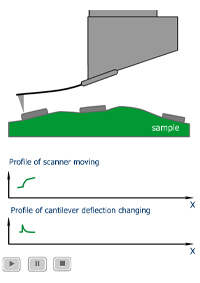
    Contact mode is the basis for all AFM techniques in which the probe tip is in constant physical contact with the sample surface. While the tip scans along the surface, the sample topography induces a vertical deflection of the cantilever. A feedback loop maintains this deflection at a preset load force and uses the feedback response to generate a topographic image.


    Contact mode is suitable for materials science, biological applications and basic research. It also serves as a basis for further SPM techniques that require direct tip-sample contact.


  • Constant Force mode

    Constant Force mode

    In Contact mode of operation the cantilever deflection under scanning reflects repulsive force acting upon the tip.

    Repulsion force F acting upon the tip is related to the cantilever deflection value x under Hooke's law: F = -kx, where k is cantilever spring constant. The spring constant value for different cantilevers usually vary from 0.01 to several N/m.

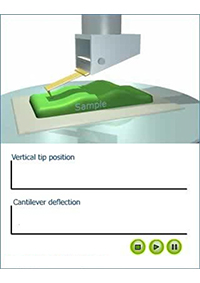
    In our units the vertical cantilever deflection value is measured by means of the optical registration system and converted into electrical signal DFL. In contact mode the DFL signal is used as a parameter characterizing the interaction force between the tip and the surface. There is a linear relationship between the DFL value and the force. In Constant Force mode of operation the deflection of the cantilever is maintained by the feedback circuitry on the preset value. So vertical displacement of the scanner under scanning reflects topography of sample under investigation.

    Constant Force mode has some advantages and disadvantages.

    Main advantage of Constant Force mode is possibility to measure with high resolution simultaneously with topography some other characteristics - Friction Forces, Spreading Resistance etc.

    Constant Force mode has also some disadvantages. Speed of scanning is restricted by the response time of feedback system. When exploring soft samples (like polymers, biological samples, Langmuir-Blodgett films etc.) they can be destroyed by the scratching because the probe scanning tip is in direct contact with the surface. Thereunto under scanning soft unhomogeneous samples the local flexure of sample surface varies. As a result acquired topography of the sample can prove distorted. Possible existence of substantial capillary forces imposed by a liquid adsorption layer can decrease the resolution.

    References

    1. Magonov, Sergei N. Surface Analysis with STM and AFM. Experimental and Theotetical Aspects of Image Analysis.VCH 1996.


  • Constant Height mode

    Constant Height mode

    In Contact mode of operation the cantilever deflection under scanning reflects repulsive force acting upon the tip.

    Repulsion force F acting upon the tip is related to the cantilever deflection value x under Hooke's law: F = -kx, where k is cantilever spring constant. The spring constant value for different cantilevers usually vary from 0.01 to several N/m.

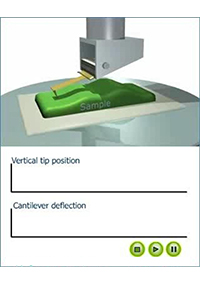
    In our units the vertical cantilever deflection value is measured by means of the optical registration system and converted into electrical signal DFL. In contact mode the DFL signal is used as a parameter characterizing the interaction force between the tip and the surface. There is a linear relationship between the DFL value and the force. In Constant Height mode of operation the scanner of the microscope maintains fixed end of cantilever on the constant height value. So deflection of the cantilever under scanning reflects topography of sample under investigation.

    Constant Height mode has some advantages and disadvantages.

    Main advantage of Constant Height mode is high scanning speeds. It is restricted only by resonant frequency of the cantilever.

    Constant Height mode has also some disadvantages. Samples must be sufficiently smooth. When exploring soft samples (like polymers, biological samples, Langmuir-Blodgett films etc.) they can be destroyed by the scratching because the probe scanning tip is in direct contact with the surface. Thereunto under scanning soft samples with relatively high relief the pressure upon the surface varies , simultaneously varies local flexure of sample surface. As a result acquired topography of the sample can prove distorted. Possible existence of substantial capillary forces imposed by a liquid adsorption layer can decrease the resolution.

    References

    1. Magonov, Sergei N. Surface Analysis with STM and AFM. Experimental and Theotetical Aspects of Image Analysis.VCH 1996.


  • Semicontact mode

    Semicontact mode
  • Lateral Force mode

    Lateral Force mode

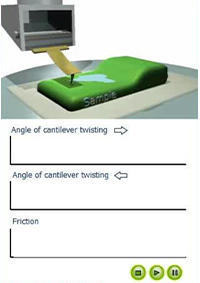
    Lateral Force mode allows to distinguish areas with different friction and also to obtain edge-enhanced images of any surface. This capability may be used in conjunction with topographical images during one scan to characterize your samples more completely.

    The physical basics of the Lateral Force mode are as follows. When scanning in the Constant Force mode perpendicularly to longitudinal axis of the cantilever, besides the cantilever's deflection in the normal direction, an additional torsion bending of the cantilever occurs. It is caused by the moment of forces acting on the tip. With minor deflections, the angle of torsion is proportional to the side (lateral) force. The cantilever's torsion bending is measured by the microscope optical recording system.

    When moving over a flat surface with zones of different friction factors, the angle of torsion will be changing in every new zone. This allows measuring of the local friction force. If the surface is not absolutely flat, such an interpretation is complicated. To distinguish zones of different friction and relief influence one can utilize second pass on the same line in opposite direction. Nevertheless, this type of measuring allows obtaining images with clearly seen minor relief details and facilitates their search. In addition, the lateral force measuring mode easily provides the atomic resolution on mica and some other laminar materials.

    Lateral Force mode has important usage for semiconductors, polymers, deposited films, data storage devices, investigative studies of surface contamination, chemical speciation and frictional characteristics, and a growing list of new applications.

    References

    1. Phys. Rev. Lett. 59, 1942 (1987). 2. Magonov, Sergei N. Surface Analysis with STM and AFM. Experimental and Theotetical Aspects of Image Analysis. VCH 1996.


  • Force modulation mode

    Force modulation mode

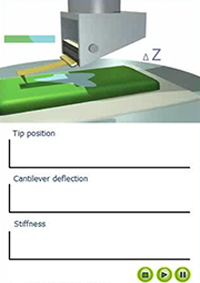
    Under realization of Force Modulation mode (FM-mode) along with scanning of sample surface as in Constant Force mode (CFC-mode) the scanner (or the sample) executes a vertical periodic motion [1]. Under this periodic motion cantilever "feels out" the sample surface. At that the pressure of the probe tip on the sample surface does not remain constant but has periodic component, usually sinusoidal. In accordance with the local elasticity of the sample value of corresponding indentation will change under scanning. On the stiff areas of the sample surface depth of indentation will be smaller, and on the compliant areas - larger.

    Tracing of the sample surface relief height is conducted by the usage of the averaged cantilever deflection in the feedback circuit [2]. If values of the scanner vertical displacement Dz, the probe tip vertical displacement D and cantilever force constant кс are known, one can determine the local elasticity of the sample under investigation кs.

    кs = кс · (Dz/D - 1)

    In turn with known value of the local elasticity one can to determine the modulus of elasticity of the sample. It can be done with usage of the calibrating measurements or with usage of the Hertzian model [3]. Force Modulation mode is widely used in polymers, semiconductors, biological, especially in composite materials investigations.


    References

    1. US Pat. 5092163.

    2. Nanotechnology 2, 103 (1991).

    3. Jonson KL. Contact mechanics. Cambridge University press: Cambridge, 1995.


  • Phase_Imaging

    Phase_Imaging
  • Spreading Resistance Image

  • Elecric Force Microscopy

    Elecric Force Microscopy

    Fig. 1. A set-up for AFM-based electrostatic modes and possible configurations of lock-in amplifiers for multi-frequency electrostatic force studies.

    The AFM modes, which are based on the detection of tip-sample electrostatic forces [1], include Electrostatic force microscopy (EFM), Kelvin probe force microscopy (KPFM) and probing of local dielectric properties in various configurations including Maxwell stress microscopy and others [2], [3]. These modes were introduced for mapping the variations of electrostatic force, measurements of local surface potential and dielectric permittivity.

    In these methods a conducting probe exercises the electrostatic force of a sample, which can be rationally modeled by considering a probe tip as an electrode in a tiny capacitor which it forms with the sample that acts as the second electrode, Figure 1 (right). For the operation of AFM-related electrostatic modes the probe is driven into a mechanical oscillation by a piezo-shaker at its flexural mode, ωmech, and the electrostatic forces are stimulated by a DC electric bias applied to the probe and/or an AC bias either at ωmech or at other frequency, ωelec. While scanning, the conducting probe simultaneously senses the mechanical and electrostatic force interactions with the sample.

    The effects of these interactions can be decoupled either by performing these measurements in separate passes at the same frequency (two-pass technique) or in the single-pass with the simultaneous detection of the mechanical and electrostatic interactions at different frequencies [2]. The latter approach requires a use of several lock-in amplifiers in the detection system, Figure 1 (left).

    References

    1. Y. Martin, D. A. Abraham, and H. K. Wickramasinghe “High-resolution capacitance measurement and potentiometry by force microscopy” Appl. Phys. Lett. 1988, 52, 1103–10005.

    2. S. Magonov, J. Alexander, and S. Wu “Advancing characterization of materials with Atomic Force Microscopy – based electric techniques”. In Scanning Probe Microscopy of Functional Materials: Nanoscale Imaging and Spectroscopy; Kalinin, S. V.; Gruverman, A., Eds.; Springer: Berlin, Germany, 2010; pp 233–300.

    3. H. Yokoyama, and M. J. Jeffery “Imaging high-frequency dielectric dispersion of surfaces and thin films by heterodyne force-detected scanning Maxwell stress microscopy” Colloids Surf. A 1994, 93, 359–373.


  • Magnetic Force Microscopy

    Magnetic Force Microscopy

    Magnetic Force microscopy (MFM) [1,2] is an effective tool for magnetic investigations on submicron scale. Image obtained by MFM is the space distribution of some parameter characterizing magnetic probe-sample interaction, i.e. interaction force, amplitude of vibrating magnetic probe etc. The magnetic probe is standard silicon cantilever (or silicon nitride cantilever) coated by magnetic thin film. MFM measurements enable the high resolution investigation of magnetic domain structure, reading and recording information in magnetic media, magnetization reversal processes etc.


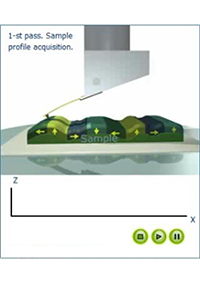
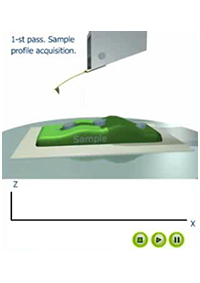
    In magnetic investigations on submicron scale first of all one must separate the magnetic image from the topography. To solve this problem the magnetic measurements are executed by means of two-pass method. In the first pass the topography is determined in Contact or Semicontact mode. In the second pass the cantilever is lifted to a selected height for each scan line (or after topography measurement), and scanned using the stored topography (without the feedback). As a result the tip-sample separation during second pass is kept constant. This tip-sample separation must be large enough to eliminate the Van der Waals’ force. During second pass the short-range Van der Waals’ force vanishes and the cantilever is affected by long-range magnetic force. Both the height-image and the magnetic image are obtained simultaneously with this method.


    In the DC MFM during second pass the deflection (DFL) of a non-vibrating cantilever is detected. DFL is caused by the magnetic interaction between the tip and the sample (similarly to contact mode). The magnetic force acting on the cantilever can be obtained by multiplying the deflection of the cantilever by the cantilever force constant. Due to a small size of the magnetic cantilever it is possible to consider it as a point magnetic dipole. In this approximation the force F acting on the cantilever during the second pass can be written in the form:


    F = (m grad) H


    where m is the effective magnetic moment of the cantilever, H is the stray field from the sample. This equation is the Zeeman energy derivative taken with the inverse sign.


    References

    Appl. Phys. Lett. 50, 1455 (1987).


    J. Appl. Phys. 62, 4293 (1987).


  • Scanning Kelvin Probe Microscopy

    Scanning Kelvin Probe Microscopy

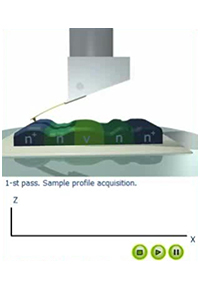
    Kelvin probe force microscopy (Kelvin mode of Scanning Probe Microscopy) was invented for measuring contact potential difference between the probe and the sample [1]. At present time Kelvin mode is based on the two-pass technique. In the first pass the topography is acquired using standard Semicontact mode (mechanical excitation of the cantilever). In the second pass this topography is retraced at a set lift height from the sample surface to detect the electric surface potential Ф(x). During this second pass the cantilever is no longer excited mechanically but electrically by applying to the tip the voltage Vtip containing dc and ac components

    Vtip = Vdc + Vac sin(wt)

    The resulting capacitive force Fcap between the tip and a surface at potential Vs is

    Fcap =(1/2) (Vtip - Ф(x))2(dC/dz)

    where C(z) is the tip-surface capacitance. The first harmonic force

    Fcap w = (dC/dz (Vdc - Ф(x)Vac)sin(wt)

    leads to suitable cantilever oscillations. The feedback then changes the dc tip potential Vdc until the w component of the cantilever (and accordingly w component of the tip-force) vanishes, e.g. Vdc(x) became equal to Ф(x). So mapping Vdc(x) reflects distribution of the surface potential along the sample surface. If no special tip-sample bias voltage is applied this distribution is Contact Potential Difference distribution.

    References

    1. Appl. Phys. Lett. 58, 2921 (1991).


  • Scanning Capacitance Microscopy

    Scanning Capacitance Microscopy

    Scanning Capacitance Microscopy is kind of dynamic EFM. Generally [1] in EFM. the cantilever is biased directly by Vtip=Vdc + Vac sin(wt), where Vac is referred to as the driving voltage. Scanning is executed on some height h above the sample surface in according with the profile defined during the first scanning in Semicontact mode. The capacitive force Fcap(z) between the tip and a sample surface at potential Vs is

    Fcap(z) =(1/2) (Vtip - Vs)2(dC/dz)

    where C(z) is the tip-surface capacitance dependent on tip geometry, surface topography and tip-surface separation z.

    Second harmonic of the capacitive force depends only on (dC/dz) and Vac

    Fcap2w(z) =(1/2) (dC/dz)Vac2 sin(2wt)

    and can be used for acquisition additional information, e.g distribution of the surface capacity over the sample. For maximization of the second harmonic oscillations the ac frequency w is adjusted to be equal to half of cantilever resonance frequency wr.

    References

    1. Nanotechnology 12, 485 (2001).

    2. Appl. Phys. Lett. 52, 1103 (1988).

    3. J. Appl. Phys. 61, 4723 (1987).

  • Piezoresponse Force Microscopy

    Piezoresponse Force Microscopy

    The basic idea of Piezoresponse Force Microscopy (PFM) is to effect locally the piezoelectric sample surface by the electric field and to analyse resulting displacements of the sample surface[1].

    The PFM technique is based on the converse piezoelectric effect, which is a linear coupling between the electrical and mechanical properties of a material. Since all ferroelectrics exhibit piezoelectricity, an electric field applied to a ferroelectric sample results in changes of its dimensions.

    To detect the polarization orientation the AFM tip is used as a top electrode, which is moved over the sample surface.

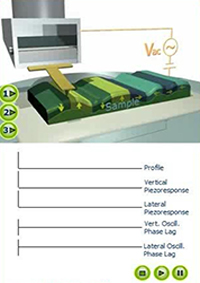
    In the Intro 1 animation one can see the reaction of out-of-plane and in-plane domains in the ferroelectric film on the voltage applied to the scanning tip in Contact Constant Force mode. The electric field generated in the sample causes the domains with the polarization parallel to the field to extend and the domains with opposite polarization to contract.

    If the polarization vector is perpendicular to the electric field, there is no piezoelectric deformation along the field direction, but a shear strain appears in the ferroelectric, leading to displacements of the sample surface parallel to itself, along the polarization direction.

    The AFM probe tip moving according to the surface displacement causes cantilever normal or torsion (because of friction) deflections. Direction of the deflection depends on the mutual orientations of the electric field and domain polarization. Correspondingly in the case of the AC electric field (see Intro 2 animation) phase lag between the electric field and cantilever deflections will depend on the their mutual orientations. In general case by analyzing the amplitudes and phases of the normal and torsion cantilever vibrations one can reconstruct the sample domain structure.

    References

    1. M. Alexe, A. Gruverman (Eds.). Nanoscale Characterisation of Ferroelectric Materials. Scanning Probe Microscopy Approach. Springer, 2004.


  • Non-contact_mode

    Non-contact_mode

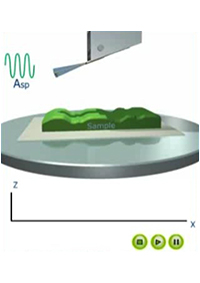
    The Non-Contact AFM (NC AFM), invented in 1987 [1], offers unique advantages over other contemporary scanning probe techniques such as contact AFM and STM. The absence of repulsive forces (presenting in Contact AFM) in NC AFM permits it use in the imaging “soft” samples and, unlike the STM, the NC AFM does not require conducting samples.

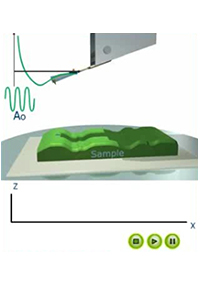
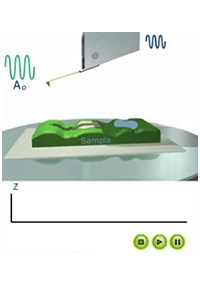
    The NC AFM works via the principle “amplitude modulation” detection. The corresponding detection scheme exploits the change in the amplitude, A, of the oscillation of a cantilever due to the interaction of a tip with a sample. To the first order, the working of the NC AFM can be understood in terms of a force-gradient model [1]. According to this model, in the limit of small A, a cantilever approaching a sample undergoes a shift, df, in its natural frequency, fo, towards a new value given by

    feff = fo (1-F’(z)/ko )1/2

    where feff is the new, effective resonance frequency of the cantilever of nominal stiffness ko in the presence of a force gradient F’(z) due to the sample. The quantity z represents an effective tip-sample separation while
    df = feff - fo is typically negative, for the case of attractive forces.

    If cantilever is initially forced to vibrate at a fset > fo, then the shift in the resonance spectrum of the cantilever towards lower frequencies will cause a decrease in the oscillation amplitude at fset as the tip approaches the sample [1].

    This change in A is used as the input to the NC-AFM feedback. To obtain a NC AFM image the user initially chooses a value Aset as the set-point such that Aset < A(fset) when the cantilever is far away from the sample.

    The NC AFM feedback then moves the cantilever closer to the sample until its instantaneous oscillation amplitude, A, drops to Aset at the user-defined driving frequency fset. At this point the sample can be scanned in the x–y plane with the feedback keeping A = Aset = constant in order to obtain a NC AFM image. The NC AFM feedback brings the cantilever closer (on average) to the sample if Aset is decreased at any point, and moves the cantilever farther away from the sample (on average) if Aset is increased. Overall, the implication of the above model is that the NC AFM image may be considered, in the limit of small A, to be a map of constant interaction-force gradient experienced by the tip due to the sample.

    The non-contact mode has the advantage that the tip never makes contact with the sample and therefore cannot disturb or destroy the sample. This is particularly important in biological applications.

    References

    1. J. Appl. Phys. 61, 4723 (1987).

  • ×

    13817907735