

Resources

Resources

Resource Center

  • Constant Current mode

    Constant Current mode

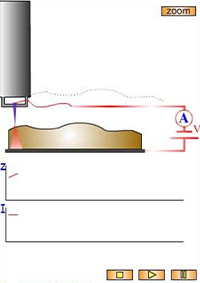
    In STM bias voltage is applied between a sharp conductive tip and a conductive sample, so when the sample is approached to a few angstroms from the tip, tunneling current occurs, that indicates proximity of the tip to the sample with very high accuracy. In Constant Current mode (CCM) of operation when scanning sample surface the scanner keeps the current constant by feedback circuit. So vertical displacement of the scanner (feedback signal) reflects surface topography.

    STM gives true atomic resolution on some samples even at ambient conditions. Scanning tunneling microscopy can be applied to study conductive surfaces or thin nonconductive films and small objects deposited on conductive substrates. The speed of scanning in CCM is restricted by usage of feedback system. Larger scanning speeds can be obtained by usage of 
    Constant Height mode (CHM), but CCM allows to investigate the samples with developed relief.

    The tunnel currents registered in the course of the measurement are sufficiently small - up to 0.03 nA (with a special STM head - up to 0.01 nA), so it is possible to investigate also low conductivity surfaces, in particular biological objects.

    Among the STM disadvantages one can mention the complexity of the results interpretation for some surfaces since the surface image received in the STM investigation mode is determined not only by the surface relief but also by the density of states, bias voltage sign and value, current value etc. For example on the highly oriented pyrolitic graphite surface one can see only each second atom. It is concerned with special arrangement of wave functions density of states.

    References

    1. Rep. Prog. Phys. 55, 1165-1240 (1992).


  • Constant Height mode

    Constant Height mode

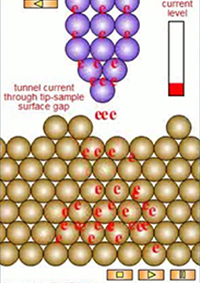
    In STM bias voltage is applied between a sharp conductive tip and a conductive sample, so when the sample is approached to a few angstroms from the tip, tunneling current occurs, that indicates proximity of the tip to the sample with very high accuracy. In Constant Height mode (CHM) of operation the scanner of STM moves the tip only in plane, so that current between the tip and the sample surface visualizes the sample relief. Because in this mode the adjusting of the surface height is not needed a higher scan speed can be obtained. CHM can only be applied if the sample surface is very flat, because surface corrugations higher than 5-10 A will cause the tip to crash. The weak feedback is still present to maintain a constant average tip-sample distance. As the information on the surface structure is obtained via the current, a direct gauging of height differences is no longer possible.

    STM gives true atomic resolution on the some samples even at ambient conditions. Scanning tunneling microscopy can be applied to study conductive surfaces or thin nonconductive films and small objects deposited on conductive substrates.

    The tunnel currents registered in the course of the measurement are sufficiently small - up to 0.03 nA (with a special STM head - up to 0.01 nA), so it is possible to investigate also low conductivity surfaces, in particular biological objects.

    Among the STM disadvantages one can mention the complexity of the results interpretation for some surfaces since the surface image received in the STM investigation mode is determined not only by the surface relief but also by density of states, bias voltage sign and value, current value etc. For example on the highly oriented pyrolitic graphite surface one can see only each second atom. It is concerned with special arrangement of wave functions density of states.

    References

    1. Rep. Prog. Phys. 55, 1165-1240 (1992).


  • I(V) Spectroscopy

    I(V) Spectroscopy

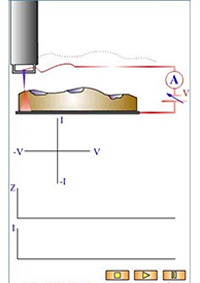
    In I(V) Spectroscopy (or Current Imaging Tunneling Spectroscopy, CITS) a normal topographic image is acquired at fixed Io and Vo. At each point in the image feedback loop is interrupted and the bias voltage is set to a series of voltages Vi and the tunneling current Ii is recorded. The voltage is then returned to Vo and the feedback loop is turned back on. Each I-V spectra can be acquired in a few milliseconds so there is no appreciable drift in the tip position. This procedure generates a complete current image Ii(x,y) at each voltage Vi in addition to the topographic image z(x,y)|VoIo.

    CITS data can be used to calculate a current difference image DIViVj(x,y) where Vi and Vj bracket a particular surface state, producing an atomic resolved, real space image of a surface state. This technique, for example can be used in UHV to image filled ad-atom states or the dangling bond states for silicon reconstructions.

    References

    1. G. Binnig and H. Rohrer: Surf. Sci. 126 (1983) 236. Rep. Prog. Phys. 55, 1165-1240 (1992).


  • I(z) Spectroscopy

    I(z) Spectroscopy

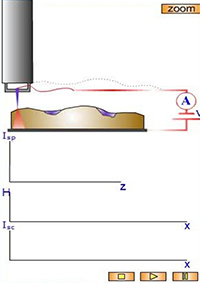
    The I(z) Spectroscopy is related to LBH spectroscopy and can be used for providing an information about the z-dependence of the microscopic work function of the surface. Next important use of the I(z) Spectroscopy is concerned with for testing of the STM tip quality.

    The tunneling current IT in STM exponentially decays with the tip-sample separation z as

    IT ~ exp(-2kz),

    where the decay constant is given by

    2k = 2(2mU/h2)1/2.

    U is the average work function Uav = (Us + Ut)/2, where Ut and Us are the tip and sample work functions, respectively.

    In the I(z) Spectroscopy, we measure the tunnel current versus tip-sample separation at each pixel of an STM image. For Uav = 1 eV, 2k = 1.025 A-1eV-1. Sharp I(z) dependence helps in determining of tip quality. As is empirically established if tunnel current UT drop to one-half with Z < 3 A the tip is considered to be very good, if with Z < 10 A, then using this tip it is possible to have an atomic resolution on HOPG.
    If this takes place with Z > 20 A this tip should not be used and must be replaced.

    References

    1. G. Binnig and H. Rohrer: Surf. Sci. 126 (1983) 236. Rep. Prog. Phys. 55, 1165-1240 (1992).


  • ×

    13817907735