

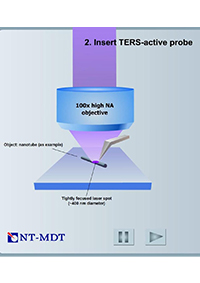
Tip-Enhanced Raman Spectroscopy (TERS) is an advanced technique that combines the high spatial resolution of Scanning Probe Microscopy (SPM) with the sensitivity of Raman spectroscopy. TERS provides detailed chemical information at the nanoscale, which is crucial for understanding the molecular composition, structure, and properties of materials at very fine scales.
Principle of TERS:
TERS works by enhancing the Raman signal of molecules in close proximity to a sharp metallic tip, usually made of silver or gold. The sharp tip, typically part of a scanning tunneling microscope (STM) or atomic force microscope (AFM), acts as an antenna to enhance the Raman scattering, thus enabling the detection of Raman signals from a localized region as small as a few nanometers.
Here's how TERS works step by step:
Raman Scattering:
Raman scattering occurs when a monochromatic light (usually from a laser) interacts with the molecules in the sample, causing the molecules to scatter the light. This scattered light is shifted in frequency by an amount that corresponds to vibrational modes of the molecules, which is the basis of Raman spectroscopy.
Enhanced Signal:
In TERS, a sharp metallic tip (typically a nano-sized tip of a metal like gold or silver) is brought very close to the sample surface. The electric field of the incident laser light is strongly enhanced at the apex of the tip, creating a localized plasmonic field. This enhancement of the electromagnetic field leads to a much stronger Raman scattering signal from the region immediately beneath the tip.
Tip-Substrate Interaction:
The electromagnetic field enhancement (known as surface plasmon resonance or SPR) is localized at the very tip of the probe. This allows TERS to detect Raman signals from a very small area (as small as a few nanometers) near the tip, which is orders of magnitude smaller than the diffraction limit of conventional Raman microscopy.
Spatial Resolution:
Traditional Raman spectroscopy has a spatial resolution limited by the diffraction of light (typically around 1 µm). However, TERS can break this limitation, allowing for spatial resolutions down to nanometer scales (typically between 10 nm and 100 nm), depending on the tip shape, material, and experimental setup.
Simultaneous Topography and Spectroscopy:
Since TERS is typically combined with atomic force microscopy (AFM) or scanning tunneling microscopy (STM), the technique allows for simultaneous acquisition of both topographical (surface structure) and spectroscopic (chemical) information at the nanoscale. This dual capability makes it highly useful for surface characterization and molecular imaging.
Key Components of TERS Setup:
Laser Source: Provides the excitation light for Raman scattering.
Metallic Tip: Usually gold or silver; it is the key to enhancing the Raman signal by creating localized plasmonic fields.
Sample: The material or surface under investigation.
Detector (e.g., CCD or spectrometer): Detects the scattered light and analyzes the Raman spectra.
Scanning Probe Microscope (AFM or STM): Provides high-resolution topographic imaging and controls the position of the tip over the sample.
Applications of TERS:
Nanomaterials: Characterizing the molecular composition and properties of nanoparticles, nanowires, and thin films.
Surface Chemistry: Investigating surface reactions and interactions at the atomic or molecular scale.
Biomolecules: Studying DNA, proteins, and other bio-molecules with nanoscale precision.
Catalysis: Observing the reaction pathways and intermediates in catalytic processes at the surface level.
Semiconductors: Analyzing the electronic and vibrational properties of semiconductor materials.
Advantages:
High Spatial Resolution: TERS can provide spatial resolutions down to the nanometer scale, much beyond the diffraction limit of light.
Molecular Sensitivity: The technique provides rich molecular information similar to Raman spectroscopy, including chemical composition, vibrational modes, and chemical bonding.
Nanoscale Surface Characterization: TERS enables the study of surface properties at the atomic and molecular level, which is particularly valuable for advanced materials research.
Challenges:
Tip-Related Artifacts: The quality of the TERS signal is highly dependent on the sharpness and cleanliness of the metallic tip. Imperfections in the tip can lead to variations in the enhancement and the quality of the spectra.
Complex Setup: The setup requires sophisticated equipment, including high-resolution AFM or STM systems, and precise alignment.
Sample Preparation: Samples need to be prepared in a way that they are suitable for TERS measurements, as the technique often requires a conductive surface and a sharp tip.
Summary:
Tip-Enhanced Raman Spectroscopy (TERS) is a powerful tool that allows for high-resolution molecular imaging and spectroscopy at the nanoscale by leveraging the electromagnetic field enhancement created by a sharp metallic tip. It combines the strengths of Raman spectroscopy and scanning probe microscopy to provide detailed chemical and structural information with spatial resolution much beyond traditional optical techniques.